
Courtland Criminal History Checks
A Courtland record search works best when it follows the life of the Courtland event. Start with the agency named on a summons, warrant, report receipt, or other paperwork. Official Virginia data confirms a Courtland Police Department, but the reviewed official sources do not publish a current Courtland police records page, form, email address, fee list, or online blotter. That gap makes agency identification important. If the Southampton County Sheriff handled the Courtland incident, its Records Management staff maintains accident and offense reports, warrants and legal papers, and local record checks.
Courtland court files take a different route. Courtland misdemeanor, traffic, town-ordinance, and preliminary felony matters begin in Southampton General District Court. A Courtland felony that is certified or indicted moves to Southampton Circuit Court. Use this order:
- Identify whether Courtland Police, the Southampton Sheriff, or another agency made the record.
- Ask that agency for the incident or arrest report, using the report number, date, place, and record type if known.
- Search Southampton General District Court case information for the first filed criminal or traffic case.
- Check Circuit Court when a felony was certified, indicted, or appealed, and call the clerk if an expected Courtland case is missing.
- Use the VSP SP-167 process only when a statewide, identity-based Virginia history is needed.
Courtland's Criminal Records Corridor
Courtland concentrates the county's main justice offices along a short part of Main Street. The Circuit Court clerk and combined district clerk work at 22350 Main Street. The Southampton Sheriff's Office and its maximum-security jail are next door at 22336 Main Street. That physical closeness does not merge Courtland records. A Courtland police narrative stays with the agency that made it. Jail staff hold the Courtland booking and custody entry. Each clerk keeps the pleadings, docket events, orders, disposition, and copy record for its court.
This compact layout helps a Courtland visitor move between the right offices, but only after choosing the right Courtland custodian. The Sheriff's Administrative Division describes Records Management as the keeper of accident and offense reports, warrants, legal papers, and local checks. The court clerks answer questions about Courtland charges and judgments. One counter cannot certify the other counter's work.
Note: Bring a case or incident number when possible because similar names alone can point to the wrong Courtland record.
Records at the Courtland Police Department
Virginia Department of Criminal Justice Services data confirms Courtland Police as a reporting agency. However, no current official municipal site, police records page, public request form, app, blotter, email, direct telephone number, or copy fee was verified in the project research. A Courtland criminal record request should not fill that gap with a guessed contact. Look first at the officer and agency shown on the summons, warrant, report receipt, or case detail.
If Courtland Police created the Courtland report, ask town or county staff, or the appropriate court clerk, to confirm the present custodian and contact route. If a Southampton deputy created it, use Sheriff's Records Management at 22336 Main Street or call 757-653-2100 before a trip. A useful Courtland request describes the incident number, date and time range, exact place, report type, involved-party status, and whether inspection or an electronic copy is sought. Some victim, juvenile, active-investigation, and personal data may be withheld or redacted.
Three Courtland Record Counters
A common Courtland error is visiting the closest public building instead of the office that owns the Courtland record. County Administration sits at 26022 Administration Center Drive and routes county-government requests. It is not automatically the custodian of a Courtland police investigation, a Sheriff's Courtland offense report, or an elected clerk's Courtland case file. The Sheriff's Records Management unit and the two court clerks have separate duties.
Sheriff's Records Management
22336 Main Street
Courtland, VA 23837
757-653-2100
Call to confirm counter access and fees.
Combined Court Clerk
22350 Main Street
Courtland, VA 23837
757-653-2673
Weekdays, 8:30 a.m. to 4:30 p.m.
Circuit Court Clerk
22350 Main Street
Courtland, VA 23837
757-653-2200
Weekdays, 8:00 a.m. to 4:30 p.m.
Call the matching Courtland office before travel when a Courtland record is old, archived, sealed, or not visible in the public index. The clerk can also explain how to request a plain or certified Courtland copy under the current fee schedule.
Booking and Arrest Records in Courtland
A Courtland arrest can create an agency report, magistrate process, jail intake, fingerprint submission, and later court case. Those are related but not interchangeable. Booking ordinarily routes through Southampton County Jail at 22336 Main Street unless the arresting agency uses another lawful facility. The jail is a 57-bed maximum-security facility for men awaiting proceedings and for people serving qualifying local sentences. Women are housed at facilities equipped for women.
Southampton publishes no verified public jail roster, booking log, or arrest blotter. For a recent Courtland arrest, call 757-653-2100, check Virginia VINELink when coverage applies, and search General District Court after a Courtland charge is filed. Then request the source Courtland report from the arresting agency. A Courtland booking allegation can later be amended, dismissed, certified to Circuit Court, or resolved in another way. It is not proof of guilt.
The broader Southampton County arrest search explains jail, agency, court, and state custody channels in more depth.
Courtland Criminal Docket Timing
Courtland has no separate modern municipal court portal. Town and local ordinance matters use Southampton General District Court at the courthouse in Courtland. The official combined-court schedule places town and local ordinance cases on Tuesday at 9:00 a.m., traffic matters on Tuesday and Friday at 9:00 a.m., and criminal matters on Tuesday at 1:00 p.m. A listed hearing is a scheduled event, not a case outcome.
Timing also explains why a new Courtland arrest may not appear at once. Courtland police and jail work comes first. A magistrate may issue process or address bail. Clerk staff then open and update the Courtland case. Weekends, continuances, data entry, and a felony's move between courts can create gaps between the event and the online index. Search by full case number when known, then confirm the record with the clerk.
Note: A General District entry marked disposed may show felony transfer, so check Circuit Court before treating it as a final outcome.
The Courtland Municipal Court File
The phrase "Courtland municipal court record" can send a search in the wrong direction. Official sources show no separate Courtland court or town case portal. Southampton General District Court hears Courtland ordinance matters, misdemeanors, traffic offenses, and the first stages of felony cases. Circuit Court hears indicted or certified felonies and appeals. Both clerks are at the Southampton Courthouse, but each maintains its own case stage and documents.
| Court Name | Southampton General District Court, with Circuit Court for transferred felonies and appeals |
|---|---|
| Case Types Heard | Town ordinances, misdemeanors, traffic crimes, and felony preliminary proceedings |
| Case Lookup Channel | Virginia OCIS or General District Case Information under Southampton, plus clerk confirmation |
| What the Docket Shows | Case number, charge, Code section, dates, status, hearings, plea, disposition, sentence, costs, and appeal data when public |
| Copies & Fees | Request pleadings, orders, indictments, or certified copies from the proper clerk; ask for the current statutory estimate |
A town court is not hiding behind the Courtland label. For any Courtland municipal matter, the Southampton court name, case number, and disposition are the keys that lead to the official Courtland case record.
Courtland Criminal Case Search Fields
The official court interface has no Courtland-only option. Select Southampton General District or Southampton Circuit, then choose the criminal or traffic path. Name search is useful when no file number is known, but it can match more than one person. A full case number is the more precise key. Compare the court, charge, offense date, hearing date, status, and case number before relying on a result.
| Field | Use in a Courtland Search | Limit |
|---|---|---|
| Court | Select the Southampton court that holds the current stage | A felony may require both courts |
| Case type | Choose Criminal/Traffic | Civil records use a separate path |
| Name | Enter last and first name, with middle name when offered | Confirm identity through public case facts |
| Case number | Use the full number from the summons or docket | Exact format matters |
| Hearing date | Use when the selected portal offers that path | It shows an event, not a judgment |
The public result is a Courtland case index, not a full scanned Courtland file. Courtland motions, exhibits, orders, and restricted attachments may require clerk review. Juvenile, sealed, expunged, and protected personal information may not appear.
How Courtland Records Reach the County
A Courtland police report remains an agency record. When an arrest is reportable, booking staff or law enforcement take fingerprints and a photograph under Virginia law and send the arrest data through Livescan and CCRE channels. The court clerks later report qualifying dispositions. Those submissions create an event-based statewide history, but they do not turn the police narrative, jail intake, and court order into one document.
Record flow: Courtland Police › Southampton County Courts › Virginia Department of State Police CCRE
Use the source closest to the Courtland question. The agency answers what Courtland officers reported. The jail answers local custody. General District or Circuit Court supplies the filed charge and result. The VSP criminal record check supplies a statewide identity-based history through SP-167, which must be generated, signed, notarized as required, paid for, and mailed or delivered. It is not an instant Courtland website result.
Courtland Charter and Record Context
Courtland was historically known as Jerusalem, and its role as county seat gives local court records a longer archival context than the current online portal can show. The official Courtland charter is a primary source for the town's legal identity. It does not serve as a police report search or court docket. Older Courtland records may require a direct clerk inquiry when they predate online coverage or remain in paper form.
The official Courtland charter page also provides a useful visual marker for Courtland's legal history:
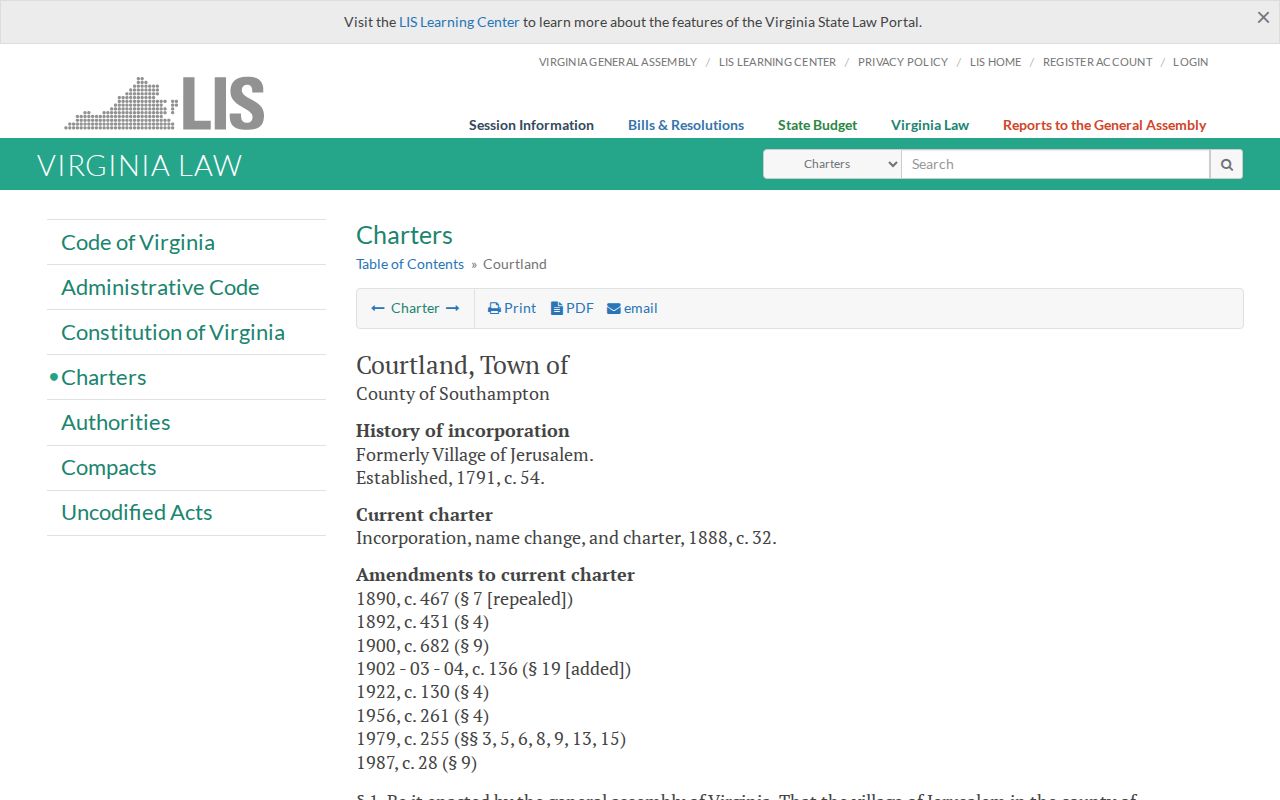
The image supports Courtland's municipal context, while current case facts still come from Southampton court files and the agency that created each report.
Courtland Felony Record Timeline
A felony connected to Courtland can leave two public court trails. The case usually begins in General District Court for arraignment and a preliminary hearing. If certified or indicted, it moves to Circuit Court for felony proceedings. The Circuit Court term begins on the third Monday of odd-numbered months, and the grand jury meets on the first day of the term unless the official schedule changes.
Courtland case flow: Arrest or summons › magistrate and bail process › General District arraignment › preliminary hearing › indictment or certification › Circuit Court plea or trial › disposition and sentence
That split can make one Courtland result look closed while the felony remains active in Circuit Court. Terms such as certified, appealed, dismissed, acquitted, guilty, deferred, and nolle prosequi describe different events. Nolle prosequi means the prosecutor chose not to proceed at that time. It is not a conviction. The clerk's certified order is the best source for a final outcome.
Courtland Records, Not Franklin Records
Courtland is in Southampton County. The nearby City of Franklin is an independent locality for court and record custody. A Franklin police event does not become a Courtland or Southampton case merely because the places are close or agencies cooperate. Select Southampton in the court interface only when the paperwork, arresting agency, or court truly points there.
This locality check prevents a false negative. Searching Southampton for a Franklin case can return nothing even when a valid case exists in Franklin's system. The reverse is also true. Read the locality on a summons or docket, identify the arresting agency, and then select that jurisdiction. For an unclear Courtland event, the combined-court clerk can confirm whether a case was filed in Southampton without guessing from a street name alone.
Note: Search each jurisdiction separately when an event near Courtland may have involved the independent City of Franklin.
Courtland Record Access Rules
Virginia law treats a Courtland police report, a public court index, and a CCRE history as distinct records. Request each from its actual custodian. Virginia FOIA can reach nonexempt agency records, but law-enforcement exemptions and redactions require a record-specific review. Court access follows the clerk statute. CCRE dissemination follows separate criminal-history rules. Public access does not override juvenile restrictions, sealing, victim protections, or limits tied to an active investigation.
A request may seek inspection or copies and should ask for a fee estimate. Southampton's county policy allows oral or written requests and generally calls for a response within five working days, subject to lawful extensions and exemptions. That county route is appropriate for county administrative records, not as a substitute for the Courtland record custodian. Send court-copy questions to the clerk and agency-report questions to the agency.
Key Statutes:
Virginia FOIA § 2.2-3704 gives qualifying requesters access to nonexempt public records and sets the ordinary response framework.
Virginia Code § 2.2-3706 governs access to law-enforcement and criminal records, including exemptions.
Virginia Code § 17.1-208 governs clerk access, court-record copies, and fees, subject to restricted records.